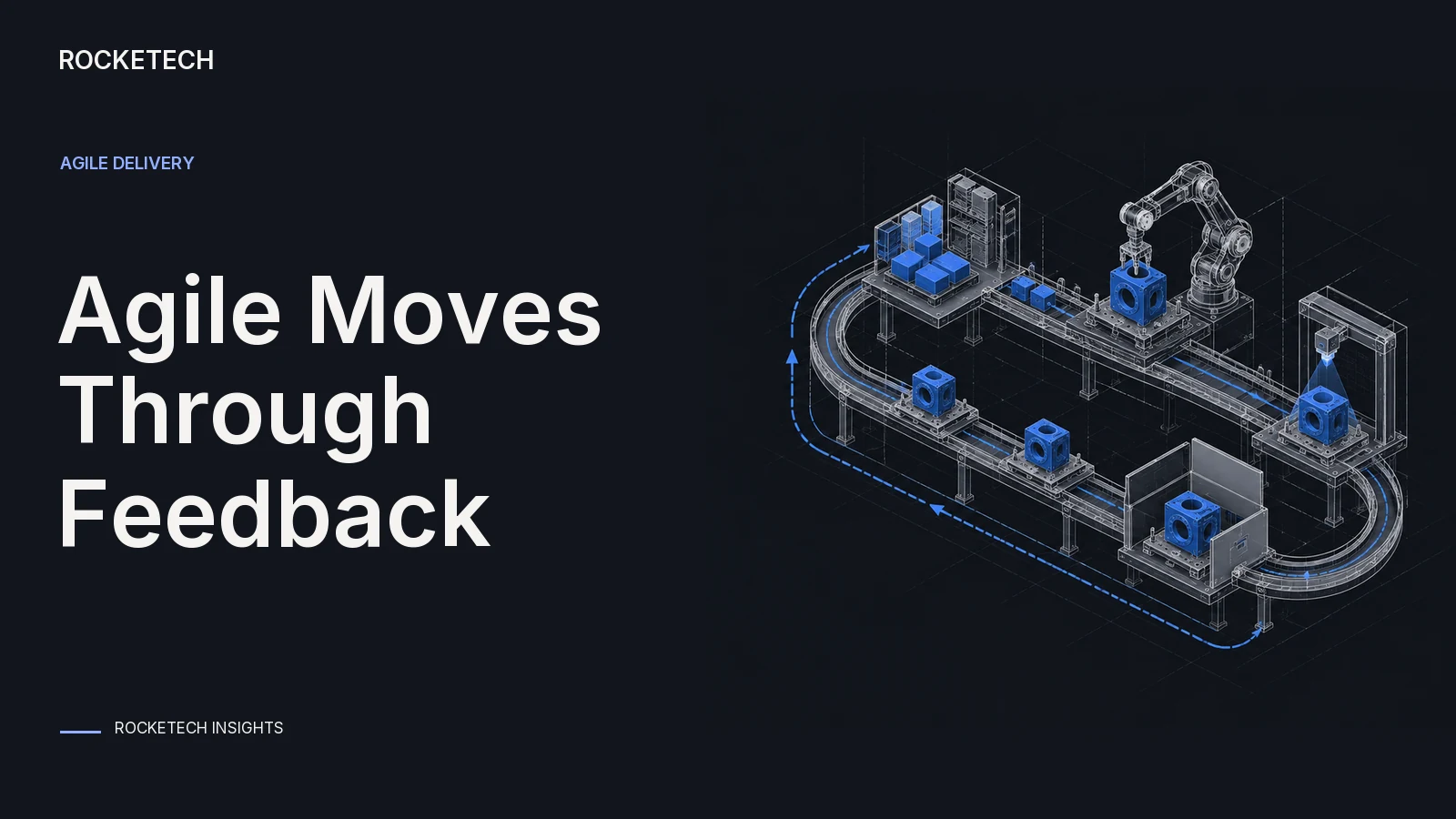
The agile software development lifecycle has the same phases as any software project: you decide what to build, plan it, build it, test it, release it and learn from users. The difference is that agile runs these phases in short loops and repeats them, instead of running each one once. The Agile Manifesto principles put the goal plainly: “Deliver working software frequently, from a couple of weeks to a couple of months, with a preference to the shorter timescale.”
No single standard owns the names of the phases. The Scrum Guide only defines the loop itself, the Sprint, at one month or less. The six names below are a common way to describe the whole lifecycle, and we use them here because each one is a point where a founder has to decide something.
The six phases of the agile lifecycle
Phase
What you decide
What you get
How long with us
Concept
The problem, the users and the first scope
A brief, user stories and a budget range
Days
Inception
The team, the design direction and the riskiest question
Scope, main flow, clickable prototype, technical plan, priced backlog
1 week as a discovery sprint
Iteration
What goes into each Sprint
Working software at every Sprint Review
A first version in 2-4 weeks
Testing
What “done” means and what blocks a release
Tested Increments and a release checklist
Inside every Sprint
Release
When and where to launch
The product live, store approval, monitoring
Days, plus store review
Review
What to change next
A reordered backlog for the next loop
Every Sprint and after launch
Agile lifecycle phases from a founder’s seat
Concept
You decide what problem the product solves, for whom, and what the first version must do. The output is a short brief and a list of user stories in order of importance. Keep the first scope narrow: one main job for one kind of user. This is also where you need a first budget range, before you talk to anyone about a contract.
Inception
Here the team forms, the design direction is set and the riskiest technical question gets tested. We sell this phase on its own as a discovery sprint: a fixed $3,000 for one week. You get a written scope, the main user flow, up to 6 main screens for one platform in a clickable Figma prototype, a technical plan, a one-day test of the riskiest technical question where there is one, and a backlog with hours and a fixed price for the build. The $3,000 counts toward the MVP if you build with us, and the files are yours either way. Our post on the discovery phase covers it day by day.
Iteration
This is the build, and it runs in Sprints of one month or less. Each Sprint starts with planning, ends with a review of working software and a retrospective, and has a 15-minute check every day. Our MVP development typically costs $5,000-15,000 and takes 2-4 weeks for a narrow first release. For a market comparison: across 95 agencies, the median published MVP starting price is $13,234 and the median promised timeline is 6 to 12 weeks (Rocketech MVP Price Index 2026, H2 edition). Those are published prices, not what agencies charge after scoping.
In agile, testing isn’t a phase that waits for the end. Every item has to meet the Definition of Done before it counts, and the Scrum Guide is strict about it: work that doesn’t meet the Definition of Done can’t be released or even shown at the Sprint Review. A final round still happens before a launch:
unit tests on each piece of code;
integration tests on the parts working together;
system tests on the whole product;
acceptance tests, where you check the product against the user stories.
AI coding tools make this phase more important, not less. The 2025 DORA report, based on nearly 5,000 technology professionals, found a positive link between AI adoption and delivery throughput, while AI adoption “does continue to have a negative relationship with software delivery stability.” Faster code needs the same checks before it reaches users.
Release
The release phase covers deployment, app store review, monitoring and the support plan. Store review can take time: on Traza, an Australian marketplace app, App Store review could take one to two weeks, so we sent the app to review early instead of polishing it until the last day. It was approved on both stores.
If you sell software in the EU, plan for security reporting from the first release. Under the Cyber Resilience Act, manufacturers have had to report actively exploited vulnerabilities since 11 September 2026, and the Act’s main obligations apply from 11 December 2027. The Act also requires manufacturers to handle vulnerabilities during the lifecycle of their products. In practice that means your release phase needs a named person who receives vulnerability reports and a way to ship a security fix fast. This is general information, not legal advice.
Review
Review happens at two levels. At the end of every Sprint, the Sprint Review shows working software to you and your stakeholders, and the backlog changes based on what you saw. After launch, real users take over that role: their behaviour and feedback reorder the backlog, and the loop starts again. Retirement, when a product or feature is switched off on purpose, also belongs here.
How the phases repeat: one loop at a time
The six phases don’t run once. A typical path looks like this, using our Subflare project, an AI lead scoring product for B2B teams:
Concept and inception: paid discovery in October 2025 produced the requirements, a user story map, the architecture and price options for each part of the scope.
A 2-week test build proved the risky AI part worked before the full build.
Iterations: from mid-November, monthly Sprints with a live demo every one to two weeks. The demos moved the dashboard and lead detail page forward and pushed lower-value work back.
Release and review: the MVP was approved for client onboarding, and the roadmap continued with a beta and growth stages.
Small batches keep each loop cheap. DORA’s AI Capabilities Model from September 2025 names working in small batches as one of seven capabilities that amplify the benefits of AI, because it “reduces friction for development teams.” For how the agile lifecycle compares with waterfall and other models, see our comparison of software development methodologies.
How we would estimate the lifecycle before you start
The concept phase needs a number before anything else exists. Our project estimate turns your brief into user stories. You confirm what is in scope, and every hour in the budget traces back to a story you kept. We check the hours the model suggests against what our team actually books on finished projects, then multiply by our published rate of $39-55 an hour.
Here is an example run of our estimate’s math with sample inputs: a mobile payments app built on a licensed payment provider, with a KYC vendor and a back-office panel. The work items are assumptions. Only the arithmetic is ours.
Lifecycle phase
Work in the sample
Hours
Concept and inception
Onboarding and KYC flows, wireframes
22
Inception
UI kit and key screens
22
Iteration
Mobile app (onboarding, balance, transfers) and back-office panel
74
Iteration
Accounts and ledger API; security, audit log and limits
72
Iteration
Payment provider and KYC vendor
28
Testing
Test plan, regression and security checks
32
Release
App store and production release
10
Total
260 hours, a budget of $8,700-18,000, about 4 weeks
Example run of our estimate’s math: payments app (inputs are assumptions)
Write the concept on one page: the user, the problem, the one job the first version does.
Get a budget range before you talk contracts.
Buy the inception phase separately if the riskiest question is technical: a one-week discovery sprint answers it for $3,000.
Run iterations of one to two weeks and attend every Sprint Review.
Put testing into the Definition of Done, including review of AI-written code.
Plan the release phase early: store review time, monitoring, and, for EU customers, a vulnerability reporting route.
After launch, let user data reorder the backlog and start the next loop.
Get free expert advice on software development for business.
FAQ
What are the phases of the agile software development lifecycle?
A common way to name them is concept, inception, iteration, testing, release and review. In agile they repeat in short loops: each Sprint plans, builds, tests and reviews a small piece, and the product is released early and improved after launch.
How long does each phase of the agile lifecycle take?
It depends on scope. With us, a discovery sprint for the inception phase takes one week, and a narrow first version takes 2-4 weeks. Across 95 agencies in the Rocketech MVP Price Index 2026, the median promised MVP timeline is 6 to 12 weeks.
Is testing a separate phase in agile?
Testing happens inside every Sprint: an item counts only when it meets the Definition of Done, which usually includes tests. A final round of system and acceptance testing still happens before a public release.
What changes in the release phase in 2026?
If you sell software with digital elements in the EU, the Cyber Resilience Act has required manufacturers to report actively exploited vulnerabilities since 11 September 2026, with the main obligations applying from 11 December 2027. Plan who receives vulnerability reports and how you ship fixes.
How is the agile lifecycle different from waterfall?
Waterfall runs each phase once, in order, and shows working software near the end. Agile repeats the phases in short loops, so you see working software every few weeks and can change priorities between loops.
The best of our blog, bi-weekly
Carefully curated content for resourceful Devs, CTOs, and PMs. No spam.