Many startup founders dream of building a unicorn, or at least making a big splash with their product. Whatever you offer, you need to know how your target audience will react before full-scale sales begin, and before most of your money is spent. That is what a minimum viable product is for. MVP development is how a startup tests its idea with real users while it can still afford to change course.
What Is an MVP?
YouTube started in 2005 as a video dating site. Instagram was originally an app called Burbn (yes, after the drink), where people checked in at places, made plans and earned points. Neither idea took off as planned. Both companies looked at their numbers, listened to users and changed direction.
MVP stands for minimum viable product. It isn’t about lines of code or a website; it’s about testing your assumptions and getting a startup to a working product quickly. Eric Ries made the idea popular through his Lean Startup method. An MVP is the earliest version of a product that real customers can use.
We took part as a research partner in GoodFirms’ study of the MVP approach, which looks at why products that don’t fit their customers fail.
The core principle can be summed up as “dream big, start small.” Each release is tested with real customers, so the company can collect feedback, find risks and mistakes early, and see whether there is demand at all.
A good MVP has three qualities:
Value from day one: it does enough that people want to start using it.
Room to grow: it contains the core of the product the company plans to build.
A feedback loop: it collects what users do and say, so the next version is better.
It Always Starts With an Idea
Finding a good idea isn’t a straight line. It runs in loops:
Problem-finding: identify the problem.
Solution hunt: look for ways to solve it.
Prototyping: build a prototype.
Testing: test the prototype.
Feedback: collect feedback.
Adjustments: make the changes.
You may go round these steps many times, sometimes back a few steps when a hypothesis fails. If the original idea proves unworkable, that’s when the product needs to pivot.
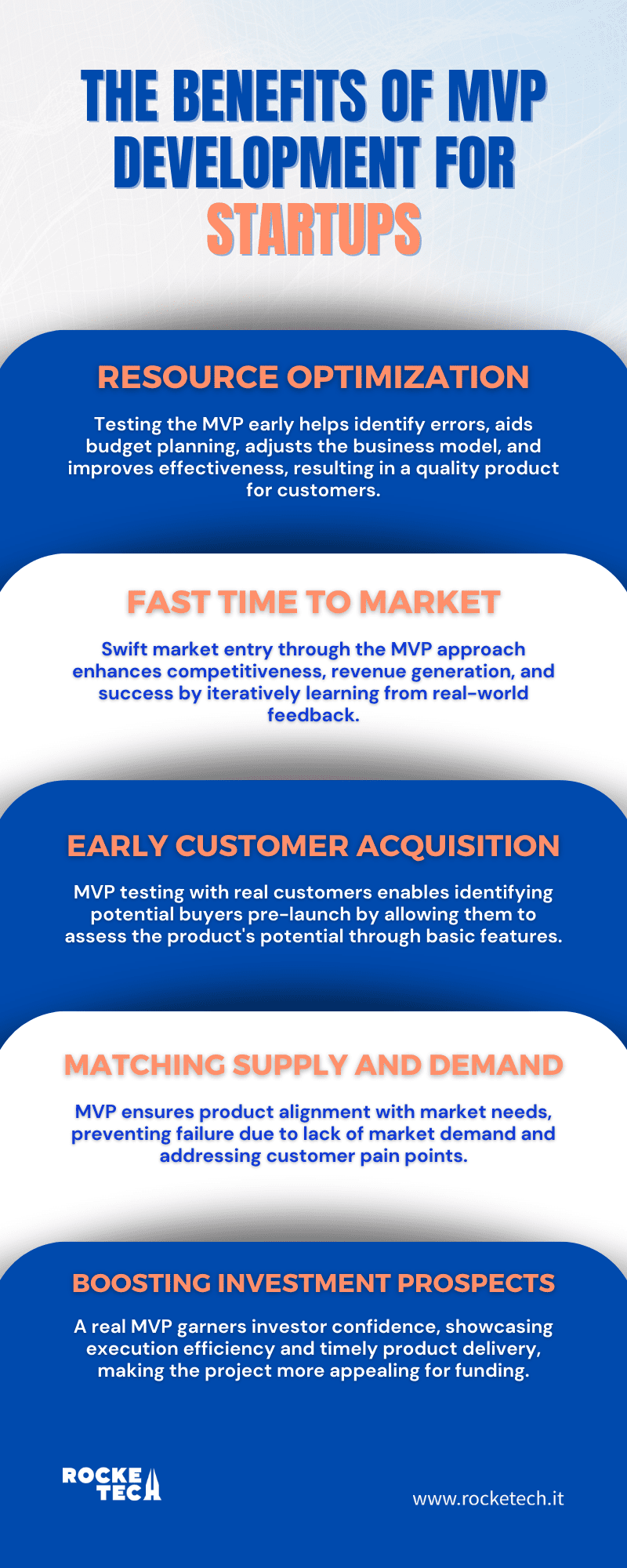
The Benefits of MVP Development for Startups
Done right, an MVP cuts costs, shortens the road to market and makes investors take you more seriously. Here are the main advantages in more detail.
Resource Efficiency
Testing with real customers early shows the errors while they are still cheap to fix. That makes financial planning easier and lets you adjust the business model before money goes into the wrong features.
Fast Time to Market
Speed matters in a startup, because the sooner you are in the market, the sooner you earn and learn. A short time to market lets you test, learn and improve the offer before the opportunity passes. AI tools have made teams faster, but speed has a cost: the 2025 DORA report found that AI adoption now goes with higher software delivery throughput and still goes with lower stability. A fast MVP still needs testing.
Early Customer Acquisition
When real customers try each version, a startup finds its first buyers before the official launch. People who use the core features can judge the product’s value for themselves, and some of them stay on as paying users.
Matching Supply and Demand
CB Insights studied 431 venture-backed startups that shut down since 2023 and found the reasons for 385 of them. Poor product-market fit came up in 43% of cases and bad timing in 29% (CB Insights, March 2026). An MVP is the cheapest way to check that the product matches what customers need before you scale it.
Better Investment Prospects
Investors are more likely to fund a product they can use than a concept on paper. A working MVP shows that the team can deliver, and its first numbers give investors something real to judge.
Using UX/UI Design to Test Business Ideas
Simple, clear interfaces help a startup test its core features quickly. Good design makes the product’s value obvious, so users try it and give feedback. Analytics then show where people get stuck. We shared our experience in two GoodFirms research projects on design: how AI is changing UX/UI design and UX for startup mobile apps.
Why Speed Matters
Imagine two hypothetical startups. MedSolution’s three founders put their savings into a platform with every feature they could think of: AI symptom analysis, full medical records, virtual tests. They spend over a year perfecting it. Meanwhile, users start to prefer simple telemedicine: quick video consultations and easy booking. By launch day, MedSolution has a rich product nobody asked for, and its investors lose patience.
VitaCare launches a stripped-down MVP instead: a simple video consultation service that connects patients with doctors. It adds features one release at a time, based on what users ask for, and grows on a small budget until it has the numbers to attract investors.
MedSolution built well but late. VitaCare built less, earlier, and let users decide what came next. Bad timing, MedSolution’s problem, came up in 29% of the failed startups in the CB Insights study.
Main MVP Types
An MVP’s job is to test the product with a real audience, and the type you choose decides how reliable that test is. There are two broad groups. Low-fidelity MVPs need little or no code, cost little and give rougher answers: is there interest, and what do people need? High-fidelity MVPs take more work and give firmer answers: will people use it, pay for it and come back? Many startups use both, one after the other.
Type
Fidelity
What you build
What it tests
Landing page or smoke test
Low
A page or ad for a product that doesn’t exist yet
Whether people click, sign up or join a waitlist
Explainer video
Low
A short video showing the idea
Interest, and which benefit people respond to
Surveys, forums and communities
Low
Questions and discussions with your audience
What people need and how they describe it
Crowdfunding or pre-orders
Low to high
An offer people pay for before it exists
Whether people will pay, and how much
Concierge or Wizard of Oz
High
A product that looks automated but is run by hand behind the scenes
Whether the service is wanted before you automate it
Piecemeal
High
A product stitched together from existing tools and services
The user journey, with little custom code
Single-feature MVP
High
A real product that does one main job
Use, payment and retention for that one job
Common MVP types and what each one tests
A single-feature MVP is what most founders mean by MVP development. If it’s an iPhone app, it has to clear Apple’s floor: the App Review Guidelines say an app should go beyond a repackaged website, and one that isn’t useful or “app-like” doesn’t belong on the App Store (guideline 4.2). Small is fine; empty is not.
What MVP development costs in 2026
Across 95 agencies, the median published starting price of an MVP is $13,234. At the 15 agencies that price both, an AI MVP starts at a median 4.8 times the same agency’s regular MVP (Rocketech MVP Price Index 2026, H2 edition). These are published prices, before any scoping.
With us, a typical MVP costs $5,000 to $15,000 and takes 2 to 4 weeks, and we build AI MVPs for the same price as any other MVP. EasySpk, an AI voice keyboard for iPhone, went from a name to the App Store in 2 weeks. On Subflare, we tested the risky AI part in 2 weeks before building the full MVP.
How we would estimate your MVP
Our project estimate turns your brief into user stories. You confirm what is in scope, and every hour in the budget traces back to a story you kept. We check the hours the model suggests against what our team actually books on finished projects, then multiply by our published rate of $39-55 an hour.
Here is an example run of our estimate’s math with sample inputs: a B2B SaaS web app with teams, roles and subscription billing. The budget came to $6,600 to $13,600 over 5 weeks. With assumed business numbers ($99 a month per customer, 80% margin, 24 months of paying, $600 to win a customer, 15 new customers a month), 8 customers pay for the build and it is paid back in month 16. Every input is a guess you can change, and the math updates.
The estimate also suggests customer groups you could sell to and gives each one a market size (TAM, SAM and SOM) with a note on what the number covers. Treat them as hypotheses to test, not verified demand. You can estimate your MVP’s cost and timeline in about four minutes.
What we would do
Name the one assumption that would sink the startup if it were wrong.
Pick the cheapest MVP type from the table that can test it.
If it needs software, keep the first release to one main job and plan 2 to 4 weeks for it.
Launch to real users, and track sign-ups, use of the main feature and payments.
Use those numbers to decide the next release, and to show investors.
Do you have a business idea that needs validation but don’t know where to start? We are here to help.
FAQ
What is MVP development?
MVP development is building the first working version of a product with only the features needed to test whether customers want it. It covers scope, design, the build, testing and launch, and it ends with a product real users can try.
How much does MVP development cost in 2026?
Across 95 agencies in the Rocketech MVP Price Index 2026, the median published starting price is $13,234. With us, a typical MVP costs $5,000 to $15,000 and takes 2 to 4 weeks.
Does an AI MVP cost more?
At agencies that price both, an AI MVP starts at a median 4.8 times their regular MVP. We build AI MVPs for the same price as any other MVP, $5,000 to $15,000.
What are the main types of MVP?
Low-fidelity MVPs, such as a landing page, a video or pre-orders, test interest with little code. High-fidelity MVPs, such as a concierge service or a single-feature product, test whether people use and pay for the product.
Why do startups build an MVP first?
To learn whether customers want the product before most of the money is spent. In CB Insights’ 2026 study of failed startups, poor product-market fit came up in 43% of cases.
Turn your assumptions into a project brief
An MVP budget is useful only when it names the learning goal and excludes optional scope. Review our startup development approach and the Guestroom case to discuss delivery choices without assuming every first release has the same cost. Explore software development for startups and the Guestroom case study.